Trilateral negotiations America – Russia – Ukraine in Abu Dhabi. #Abu Dhabi#Russia#trilateral negotiations#Trump#Ukraine#USA#War on Ukraine
Welcome to the Situation Centre. Today, a special focus on the trilateral negotiations America – Russia – Ukraine in Abu Dhabi.
(Transcript of a broadcast in Czech Radio – Rádio Plus)
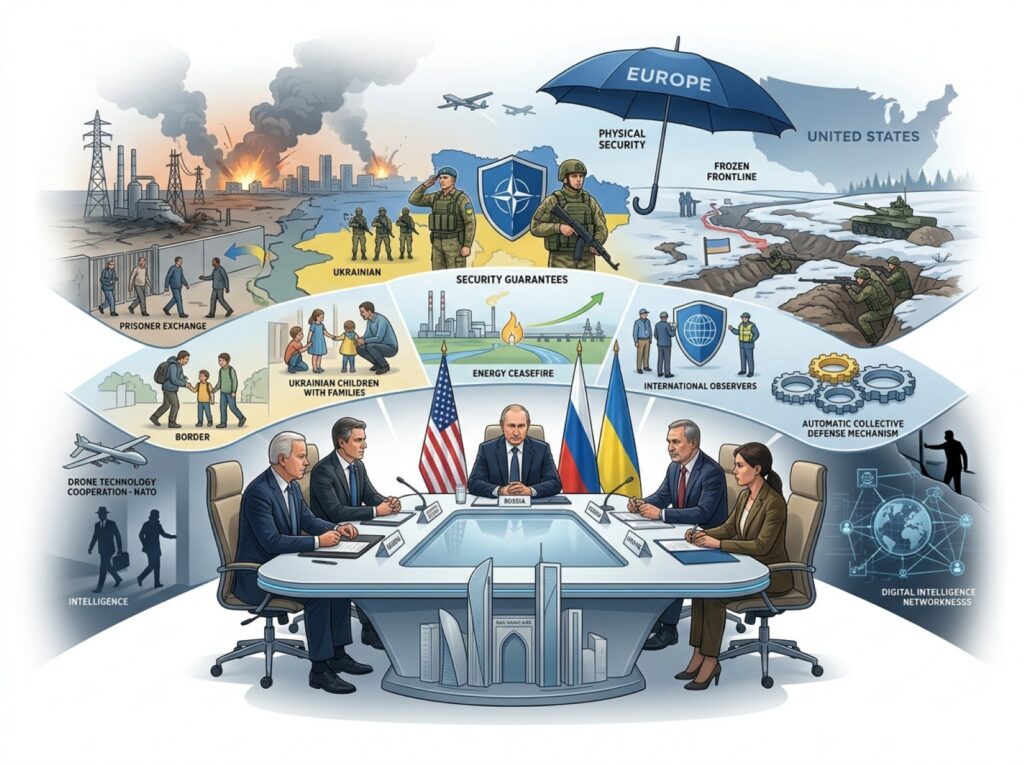
In Abu Dhabi, talks were held on the exchange of prisoners and the return of Ukrainian children to their homeland. President Volodymyr Zelenskyy spoke about being pleased with the change in the approach of American negotiators – although the specific results and conclusions of yesterday’s talks are not yet clear.
Further meetings between negotiators from Kyiv, Moscow and Washington are expected following renewed Russian attacks on Ukraine’s critical infrastructure. At least two people were killed in Dnipro, with others injured. Two additional casualties are reported by authorities in the Vinnytsia region.
We will now discuss the military context of the peace negotiations with Pavel Macko, a retired Lieutenant General and former senior representative of Slovakia in NATO structures.
Presenter: Good morning.
Gen. Pavel Macko: Good morning.
Front Line: No Significant Russian Advance
Presenter: General, from the perspective of the military strategy of both armies, what has changed since the last negotiations in this format, which took place in February?
Gen. Pavel Macko: The fundamental change is that essentially no advance on the front line by Russia has taken place this year. Their offensive progress has stalled compared to last year. In the first ten months, they gained practically 120 km², which is absolutely negligible.
On one hand, Russia is making slight advances in some places, but the Ukrainians have managed to stabilise the Donbas and the front line and halt the Russian advance. And this is the fundamental change. Russia has therefore shifted its pressure to bombing strategic infrastructure within Ukraine.
Military Prerequisites for Peace Negotiations
Presenter: What could the military prerequisites for peace look like – including the withdrawal of Ukrainian units from Donbas, which Ukraine understandably does not demand?
Gen. Pavel Macko: There are several demands. Russia is still communicating that it wants Ukraine to hand over all occupied territories. However, the approaches differ:
▪️Russia demands an overall security solution first, and then a ceasefire
▪️Ukraine demands the exact opposite
The absolute sticking point is agreeing on security guarantees and their nature, as well as the size and status of the Ukrainian army – where positions currently diverge fundamentally. Russia does not want any observer or foreign stabilisation forces in Ukraine. Ukraine, on the other hand, demands guarantees to prevent Russia from resuming aggression – i.e. guarantees similar to Article 5 of the North Atlantic Treaty, even if Ukraine is not a NATO member.
Three Pillars of Security Guarantees
Presenter: What could potentially be included among the very specific security guarantees mentioned by President Zelenskyy?
Gen. Pavel Macko: There are three categories:
1️⃣ Building the Ukrainian army – a long-term commitment from Western partners that Ukraine will have access to new technologies and modern equipment
2️⃣ The presence of observers who would monitor the situation directly on Ukrainian territory – though not necessarily close to the contact line
3️⃣Automatic involvement of security guarantors in the event of renewed Russian aggression
A positive signal is that Ukraine also acknowledges that both sides need security guarantees and their concerns must be heard. Russia, however, is at the opposite pole – demanding the minimisation of the Ukrainian army.
American vs. European Guarantees: Who Will Bear the Weight?
Presenter: The question of the balance of guarantees remains. To what extent would it be an American guarantee, and to what extent guarantees from European allies?
Gen. Pavel Macko: Looking purely from the Western perspective, I believe it is generally accepted that physical – i.e. conventional – guarantees would be provided by European countries. These are major countries such as France, Germany, Britain, the Nordic countries and Poland. The United States would serve as a second line of defence and strategic support – whether in the area of intelligence or other elements of logistical support.
This would allow the United States to free up its hands for its priorities in the Pacific and the Middle East, while remaining committed to European security. The burden would shift to European countries.
Can Europe Replace American Support?
Presenter: I am asking about this balance precisely because there is much discussion in world media about the extent to which European military aid could replace American support – specifically regarding American satellite intelligence from the battlefield.
Gen. Pavel Macko: Absolutely – this is precisely that strategic support. 80% of all intelligence information – including that used by European countries – comes from the United States. Europe also does not have a low-orbit satellite constellation, something like Starlink. It is being considered, but it will take years.
This means that when it comes to supporting Ukraine:
▪️Europe would cover a large part of the required systems
▪️It would not cover satellite support
▪️It would not cover higher-level air defence assets – such as the Patriot system
▪️Everything else Europe would either cover, or Ukraine together with European partners could produce it
Energy Ceasefire – The Most Likely Scenario
Presenter: Today in Abu Dhabi, energy is also on the agenda. Can we therefore expect that any potential ceasefire – if one were to be agreed – would be of an energy nature?
Gen. Pavel Macko: It is the most likely scenario that an energy ceasefire would be agreed. But there is a significant imbalance. Russia currently – despite being noticeably affected by Ukrainian strikes on its own energy infrastructure – still has the advantage, because energy is right now the bottleneck ahead of the approaching winter for Ukraine.
Ukraine is running on three nuclear power plants and five conventional ones, with the conventional ones under systematic pressure. Russia is furthermore destroying distribution systems and heating plants – central nodes – which significantly complicates Ukraine’s situation.
An energy ceasefire would help Ukraine; however, limiting strikes exclusively to refineries, for example, would be disadvantageous for Ukraine. Nevertheless, it is an area where the parties could reach an agreement.
The Oleshky Example: A Model for De-escalation
Presenter: What potential model could the events in Oleshky represent – a humanitarian ceasefire in occupied territory, where the local residents were successfully evacuated to Ukraine?
Gen. Pavel Macko: This is one of the areas where relative agreement already exists during these negotiations – at least from what is emerging publicly. Oleshky serves as an example of de-escalation mechanisms. While the overall resolution of security guarantees and the sequence of steps – whether there should first be a ceasefire and then further steps – remains unclear, the de-escalation mechanism itself: how to agree on a partial ceasefire, how to monitor each other and build trust during a ceasefire – this is precisely what the Oleshky example can serve as a model for.
Sharing Experience Between Armies
Presenter: Regarding other matters relating to military cooperation – is the sharing of experience between European armies and the Ukrainian army currently realistic? After all, the Ukrainian army now has significant know-how, particularly in the area of drones.
Gen. Pavel Macko: This is happening very intensively. It is also happening through support for Ukraine – sharing technological data that is immediately reflected in the development of new military technologies, including counter-drone defence directly in the West. Moreover, NATO member states and Ukraine have a joint analytical and training centre in Bydgoszcz, Poland, where Ukrainian officers are directly present and sharing these experiences.
So this is an area where European partners are significantly learning new procedures, tactics and the implications of technological changes. On the other hand, they are able to provide Ukraine with modern equipment and technological and informational support.
Report on the Detention of Polish Agents in the Kaliningrad Region
Presenter: Finally – how seriously, from the perspective of a military expert, should we take the report that the Russian intelligence service FSB claims to have detained two agents of Polish intelligence services and accuses them of espionage in the Kaliningrad region?
Gen. Pavel Macko: I would take it as a standard report. It is likely that the Poles will deny it and the Russians will continue to repeat this claim. It is understandable that Polish authorities are interested in what is happening in the Kaliningrad region, which creates a dangerous enclave bordering Poland. It is a kind of routine intelligence noise. Countries have their intelligence interests, they try to find out as much as possible about the intentions and capabilities of a potential adversary. And this is just an episode in the overall system of gathering information from both sides.
Presenter: Thank you for the interview.
Gen. Pavel Macko: Thank you for the invitation, have a pleasant day.
Source: Český rozhlas, Rádio Plus
Podcast in Czech/Slovak: https://www.podbean.com/eas/pb-6ma6d-1bad2ba
NASPAŤ